
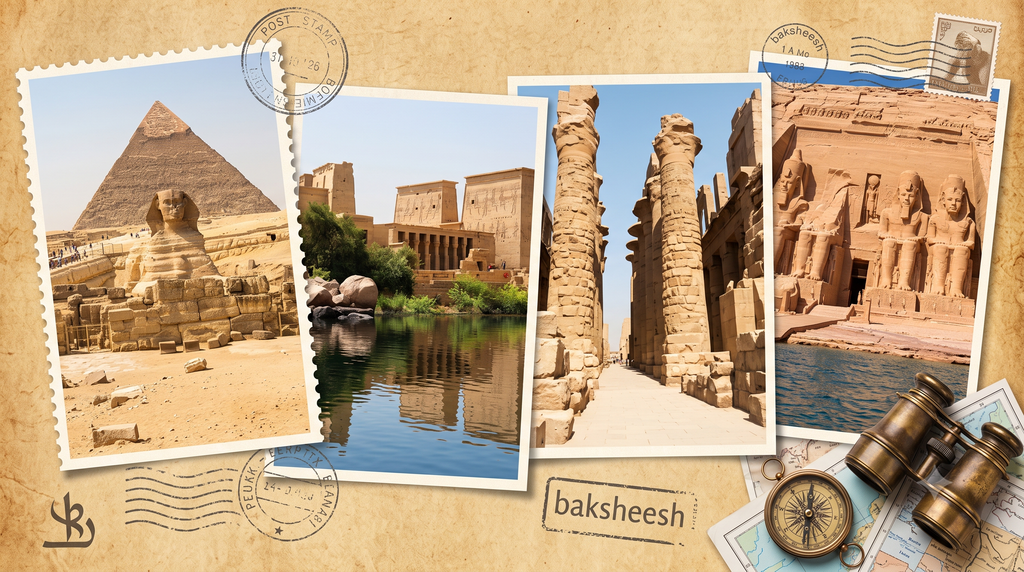
From the sprawling limestone plateau on the edge of Cairo to the desert frontiers near the Sudanese border, Egypt holds some of the most monumental architecture ever constructed by human hands. While the Nile valley is dotted with hundreds of ancient sites, four monumental locations stand out as essential stops for every first-time visitor: The Pyramids of Giza, Philae Temple, Karnak Temple, and the colossal temples of Abu Simbel.
Here is an architectural and historical guide to each landmark, complete with on-the-ground visitor tips to help you navigate them seamlessly.
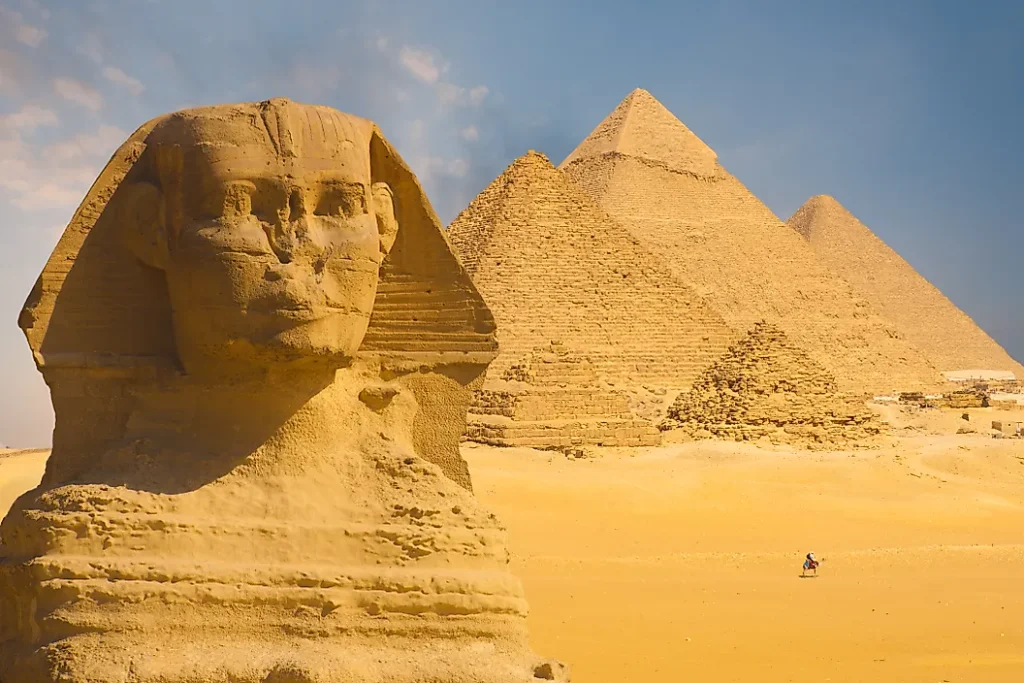
1. The Great Pyramids & The Sphinx (Giza Plateau)
Situated on the western desert rim just outside Cairo, the Giza Plateau is home to the sole surviving ancient Wonder of the World. Engineered during the Old Kingdom’s Fourth Dynasty (c. 2500 BCE), these royal mortuary monuments were designed to ensure the eternal afterlife of Egypt’s divine pharaohs.
The Great Pyramid of Khufu (Cheops): The largest of the three, originally rising 146.6 meters and assembled from over 2.3 million cut limestone blocks.
The Pyramid of Khafre: Slightly smaller than Khufu’s but built on elevated bedrock, retaining its original smooth limestone casing stones at the apex.
The Pyramid of Menkaure: The smallest of the trio, distinguished by lower courses of imported red Aswan granite.
The Great Sphinx: A colossal limestone monolith depicting a lion’s body with Khafre’s crowned head, guarding the eastern approaches to the necropolis.
Visitor Insight: General admission grants you access to walk around the exterior of all three pyramids and the Sphinx compound. Internal tickets to enter the burial vaults of Khufu or Khafre require separate tickets that must be purchased at the main ticketing counters before passing through security gates.
2. Philae Temple (Aswan)
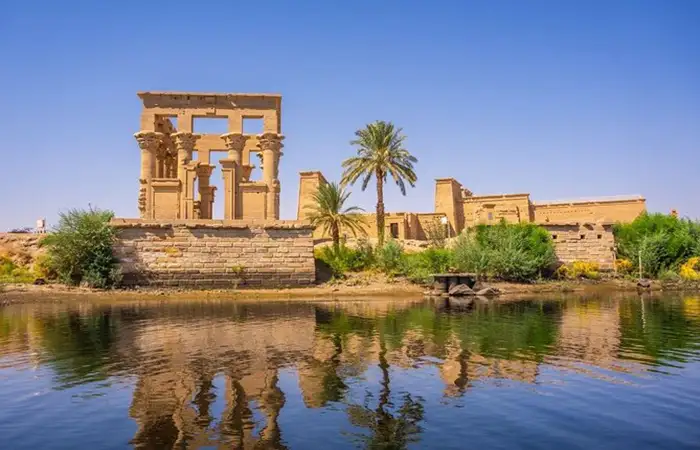
Perched on Agilkia Island in Lake Nasser, Philae was the legendary burial place of Osiris and the epicenter for the cult of the goddess Isis—the universal mother, protector, and healer. Philae is historically significant as the last major temple complex where ancient Egyptian hieroglyphic inscriptions were actively carved before the rise of Christianity.
Greco-Roman Pylons: Built during the Ptolemaic and Roman eras, the temple pylons feature scenes of kings offering tributes to Isis, Horus, and Hathor.
Trajan’s Kiosk: An unfinished open-air Roman pavilion featuring 14 sandstone columns overlooking the waters of the Nile.
The UNESCO Rescue Feat: When the construction of the Aswan High Dam threatened to submerge the complex permanently beneath Lake Nasser, UNESCO dismantled the entire structure into 40,000 blocks and reconstructed it on the elevated, landscaped Agilkia Island.
Visitor Insight: Philae is accessible only by traditional motorized wooden boats from the Marina Shellal dock south of Aswan. Arrive in the late afternoon to see the sandstone columns glowing against the blue waters of the Nile.
3. Karnak Temple Complex (Luxor)
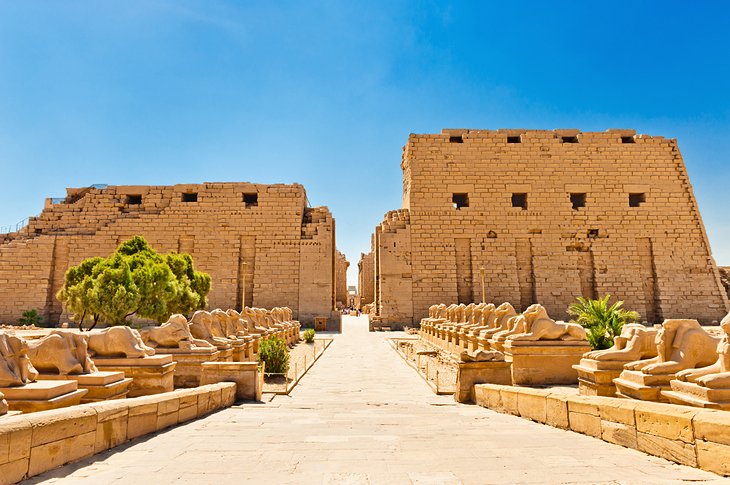
Covering over 200 acres on Luxor’s East Bank, Karnak was the cult epicenter of the state deity Amun-Ra during Egypt’s New Kingdom. Developed, modified, and expanded across 1,500 years by more than 30 successive pharaohs, it remains the largest religious complex ever constructed
The Great Hypostyle Hall: One of the architectural marvels of the world, housing 134 towering stone columns shaped like blooming papyrus plants. The central pillars rise 21 meters high, once supporting a massive stone slab roof.
The Obelisks of Hatshepsut and Thutmose I: Monumental granite spires carved in Aswan and floated downriver to puncture the desert sky.
The Sacred Lake: A massive artificial basin where high priests conducted daily purification rituals before entering the inner sanctums.
Avenue of Sphinxes: A 3-kilometer ceremonial procession path lined with hundreds of ram-headed and human-headed sphinxes connecting Karnak to Luxor Temple.
Visitor Insight: Give yourself at least 2.5 to 3 hours to cover Karnak. It is massive, and shade is scarce outside the Hypostyle Hall, so carry plenty of water and wear sun protection.
4. Abu Simbel Temples (Lake Nasser)
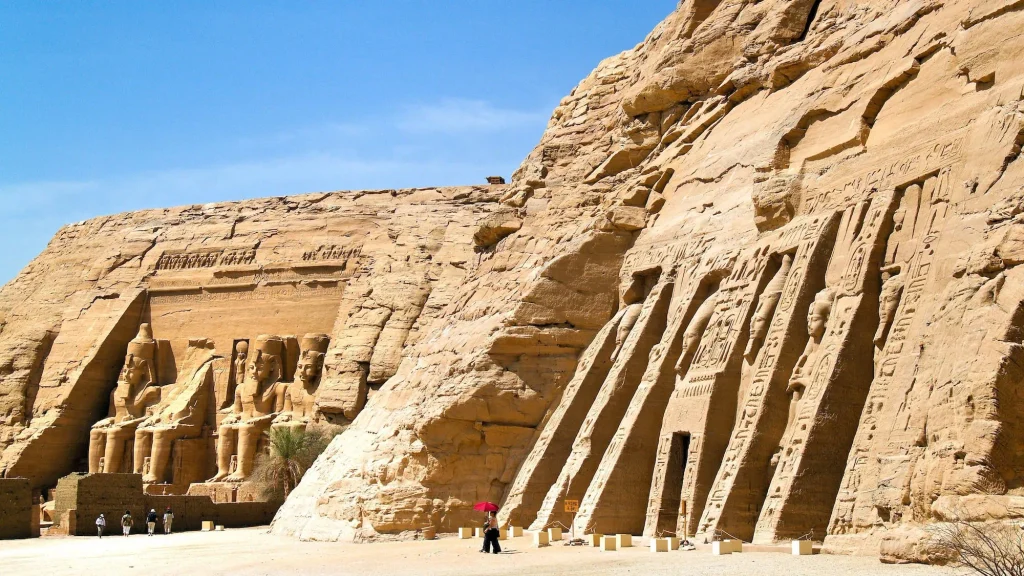
Carved directly into vertical sandstone cliffs near Egypt’s southern frontier with Sudan, the twin rock-cut temples of Abu Simbel were constructed by Pharaoh Ramesses II (Ramesses the Great) around 1264 BCE.
The Great Temple: Flanked by four colossal 20-meter seated statues of Ramesses II wearing the double crown of Upper and Lower Egypt. Inside, the pillared hall leads to an inner sanctuary housing statues of Ra-Horakhty, Amun-Ra, Ptah, and the deified Ramesses himself.
Solar Alignment Phenomenon: The interior of the Great Temple was engineered so that on two days of the year (February 22 and October 22), the rays of the rising sun penetrate 60 meters deep into the mountain to illuminate the seated statues, leaving Ptah (the god of the underworld) in shadow.
The Small Temple (Temple of Hathor): Built to honor Queen Nefertari, Ramesses’ royal wife. Notably, the statues of Nefertari flanking the entrance facade were sculpted to the exact same scale as the pharaoh—an extraordinary honor rarely granted to Egyptian queens.
Visitor Insight: Reaching Abu Simbel from Aswan requires an early-morning 3-hour overland desert drive (typically departing between 4:00 AM and 5:00 AM) or a short domestic shuttle flight. Early morning arrivals allow you to view the facade before the high noon desert heat.
Quick Comparison: The 4 Key Egyptian Landmarks
| Monument | Location | Era Built | Dedicated To | Primary Architectural Feature |
| Giza Pyramids | Cairo / Giza | Old Kingdom (~2500 BCE) | Khufu, Khafre & Menkaure | Colossal limestone pyramids & Great Sphinx |
| Philae Temple | Aswan | Ptolemaic-Roman (~380 BCE) | Goddess Isis | Island setting & Trajan’s Kiosk pavilion |
| Karnak Complex | Luxor (East Bank) | Middle to New Kingdom | Amun-Ra, Mut & Khonsu | Hypostyle Hall with 134 towering stone columns |
| Abu Simbel | Lake Nasser | New Kingdom (~1264 BCE) | Ramesses II & Queen Nefertari | Four 20m rock-cut mountain colossi |
Discover Egypt with Marvellous Milestone
Planning site entries, domestic transit between Cairo and Upper Egypt, and securing licensed Egyptologist guides can be complicated to coordinate alone.
When you travel with Marvellous Milestone, all key transport links—including our 1st-class overnight sleeper train, 5-star Nile cruise, and overland desert convoys to Abu Simbel—are seamlessly arranged.
- Escorted Small Group Departures: Strictly capped at 16 travelers per tour
- Upcoming Departures: November 2026 & February 2027
- Call / WhatsApp Inquiries: +91 620 751 0218
- Official Website: marvellousmilestone.com
[Book My Egypt Group Departure Now]
Book your next adventure with our small group travel egypt, including customized egypt tour packages from kolkata and egypt tour packages from ahmedabad. Explore wildlife with premium african safari packages, exciting group safari kenya, and complete kenya trip packages.